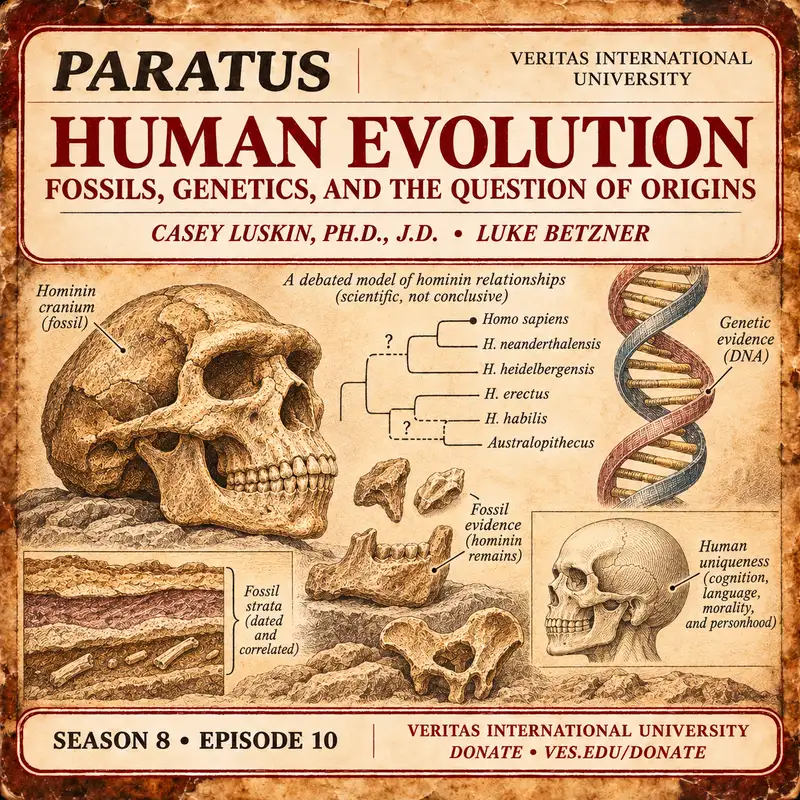
Human Evolution: Fossils, Genetics, and the Question of Origins | Casey Luskin, Ph.D., J.D.
Download MP3Welcome to Paratus, the broadcast ministry of Veritas International University. Paratus seeks to help Christians develop a biblical worldview, preparing believers to think scripturally and soundly about the Christian faith and our culture. To learn more about Veritas International University, visit our website at ves.edu. That's ves.edu.
Luke Betzner:Thanks for listening to Paratus, where we defend and discuss unchanging truth and changing times. I'm your host, Luke Betzner. Joining me on the podcast today is doctor Casey Luskin. Welcome, Casey.
Dr. Casey Luskin:Great to be with you, Luke.
Luke Betzner:I'm excited to be with you again. You've been a part of so many of our conversations as we're beginning to conclude this portion of our season on Paratus. I'm very much looking forward to our conversation today as we turn our attention to science and the Christian faith. We'll be using doctor Holden's Demski and Luskin's book, the comprehensive guide to science and faith as our text. Last episode, we explored irreducible complexity with yourself and doctor Jonathan McClatchy.
Luke Betzner:Today, we'll explore evaluating human evolution. Before we begin our discussion, Casey, I'm going to have you say a bit about yourself as well as the work that you do for the benefit of our audience.
Dr. Casey Luskin:Sure. So I work at Discovery Institute, which is a nonprofit think tank that is known as the main supporter of intelligent design. My background is I have a Ph. D. In geology from the University of Johannesburg and also a law degree from the University of San Diego.
Dr. Casey Luskin:And while I lived in South Africa, my Ph. D. Was on early plate tectonic history of South Africa, so I did not actually study paleoanthropology or human origins officially in my Ph. D. But while I lived there for about four and a half years, I had many opportunities to visit many of the famous hominid fossil sites in South Africa.
Dr. Casey Luskin:Got to even go on a sampling expedition once at the cradle of humankind and, had some great opportunities to meet a lot of folks in the field of paleoanthropology and learn a lot. So that sort of really, I guess, you could say increased my interest in the study of human origins. But my day job at Discovery is I'm our research director, so we have a large research program funding scientists who are looking at the evidence for design and nature, and a lot of what I do is making sure that our scientists are funded to have the resources they need to do their research. And I wanna say, Luke, that it's a little bittersweet coming to the end of this season of the Paratus podcast with you. You've been a great host, and I've really enjoyed all the conversations that we've had.
Luke Betzner:Well, it's been my pleasure to be able to speak to so many folks who have such great expertise as yourself and very grateful for the generosity that you've shown with your time as well as all the information that you've poured into us here for the benefit of our audience. I couldn't have been in better conversations about this stuff. Very, very excited about that. So I'm going to go ahead and jump right in now that we've just stated one of those, you know, what do they call them? $10 words.
Luke Betzner:That's so... It's very precise. Paleoanthropology. So why is paleoanthropology described as a fragmented field? And how does that affect claims about a clear fossil history of human evolution?
Luke Betzner:Let me unpack just a little bit there. When we're talking about human evolution in juncture with paleoanthropology, of course, and the field generally of what some people may recognize the word paleontology. If I'm not mistaken, Casey, but I want you to unpack this for us a little bit. Paleoanthropology has to do not strictly with paleontology, but it's sort of nested underneath that, if correct. And this is about human fossil history.
Luke Betzner:Correct?
Dr. Casey Luskin:Yeah. I think that paleoanthropology is kind of a portmanteau of the word, you know, paleontology and the word anthropology. Anthropology, obviously, is the study of humanity, and humans, paleontology being the study of fossils. So paleoanthropology is really the study of the the origins of humanity often using fossils, but not just fossils. It could be using archaeological artifacts.
Dr. Casey Luskin:It could be studying, from an evolutionary perspective, you know, studying their evolution and, you know, what what was the climate like where humans supposedly first evolved. And certainly, now that we're able to extract DNA from some older fossils, even using DNA to study human origins. Now... So I would just say paleoanthropology is the scientific field that studies the origins of humans. The evolutionary community will then add in the, you know, the the evolution of humans because they equate origins with evolution.
Dr. Casey Luskin:I don't think that that is an equation that's necessarily, required, but I... But still, you know, we're studying human origins through science, and that's what paleoanthropology does. But you actually... Did you also ask me about sort of what are some of the the the the problems with the field of paleoanthropology? Well, I often like to say that the field of paleoanthropology is a fragmented field, and I mean that in three different ways.
Dr. Casey Luskin:Number one, when you look at the actual fossils, the fossils themselves are heavily fragmented. You often just find a little bone scrap. If you find, you know, the head of a femur or part of a, you know, a a pelvis, just a just a fragment of a pelvis, you have made a hugely important find in the field of paleoanthropology even though you just found a little fragment of a bone. Okay? So the fossils themselves are heavily fragmented.
Dr. Casey Luskin:People get excited when they find a little scrap of a jaw or a tooth, and they'll reconstruct the whole thing and say, behold your new ancestor. Okay? And, of course, a lot of imagination interpretation often goes into those reconstructions, but that is... Just gives you a sense of... You know, because these these fossils are so fragmented, people get very excited when they find something that, you know, most of us would look at that and say, well, that that belongs in the trash can.
Dr. Casey Luskin:Should we put that in the compost or the trash bin? Which one does it go in? But, no, in the field of paleoanthropology, of course, I'm joking. You should never throw away a fossil. It's a complete joke.
Dr. Casey Luskin:But, you know, the the reality is they they get very excited, which is when they find a little bit of of bone. The record is also fragmented. What do I mean by that? Well, there are basically huge gaps in the fossil record where you don't really have a lot of fossils. There are not a lot of fossils to begin with.
Dr. Casey Luskin:And I love this. There's a quote from Jerry Coyne who is an evolutionary biologist at the University of Chicago. He, said that paleoanthropology is a field in which the students far outnumber the objects of study. Okay? So you don't have a lot of data to go on.
Dr. Casey Luskin:You know, the record is very fragmented. The fossils themselves are fragmented, but even then, you know, they are few and far between. And so there's just not a lot of data to go on. So the field, or the record itself is very, very fragmented. And finally, the field of paleoanthropology is fragmented.
Dr. Casey Luskin:I've read a lot of books and articles about paleoanthropology, and they invariably will tell stories of one research group in paleoanthropology getting jealous or political with another research group refusing to share bones, access to research sites, data that they've collected. It's a very, very... It's a it's a a that is fiercely political, and there's a lot of interesting stories to be told. And so I would say the field is very fragmented as well. And probably a big part of that is because, number one, we're dealing with a subject of studying the origin of humans.
Dr. Casey Luskin:Right? There's a lot of prestige. You could be the guy that discovers that fossil that shows how humans evolved. Right? That's a lot of prestige that comes along with making a discovery like that.
Dr. Casey Luskin:And so there's just a lot of emotion that's invested because it is human origins. And then, number two, you know, the data's so sparse. There's a lot, there's not a lot to go on. And so people are very competitive trying to get access to the bones and sites and the specimens that have been discovered. So it's a field that is heavily fragmented and it just makes for a lot of interesting dynamics as you study this subject.
Luke Betzner:Well, that definitely sounds like a very challenging landscape to try to navigate when it comes to trying to put it all together into a cohesive whole, especially if there's silos around scholarship and the empirical evidence that's supposed to establish it. That's a tough threshold, especially if you're trying to do research. So that
Dr. Casey Luskin:You you you just made the point that I should have made. Okay? Like, the point of all everything I just said is that the data is sparse. The, you know, the field is is sort of people are often at each other's throats. So that being the case, is this a field that really is giving us a clear picture of what really happened when they claimed, okay, this is the latest human ancestor.
Dr. Casey Luskin:How much can we really trust what is coming out of this field? So that is sort of the punchline of what I'm trying to say here. You really gotta understand that... Take everything with a major grain of salt when it comes out of this field.
Luke Betzner:And just analogously for our listeners, this is something that was similarly happened in the historical field when Soviet scholarship was completely cut off from the rest of the world. There were so many things that we just did not know. We only had one side of what that conversation looked like, if that. And so when that finally started coming out, it completely changed the conversation of the scholarly and academic sphere in a positive way. So I really hope that those types of things are able to be reconciled.
Luke Betzner:I do wanna ask this. I don't wanna go too far afield with this, but perhaps it's just the nature of this... The type of science that's being deployed. But it always seems like there's a whole lot more animal bones than there are human bones. Obviously, there's probably much more animal life on the earth than there is human life, but it seems like we have had a much more difficult time finding complete human remains than we have finding complete animal remains, or am I remiss in thinking that?
Luke Betzner:Is there some type of proportional relationship there, or has anyone looked at that in the field to find out if that's a driver?
Dr. Casey Luskin:I mean, I could probably channel what the average paleoanthropologist would say in response to a question like that. I mean, first of all, we're one species. You know? Or maybe there's there's... Actually, these days, people would say that there are multiple species of Homo that have existed.
Dr. Casey Luskin:But there's far more other animals out there. Right? And so everybody likes to use these caves as dens, places to live. Humans were probably cohabiting these caves with, you know, with with rats and with maybe even, you know, larger animals as well. So so there's just a lot of other species besides humans to live in these caves.
Dr. Casey Luskin:Additionally, I think it is pretty well accepted that that ancient human population sizes were pretty small. Okay? So, yes, they existed, but you may have had larger populations of other mammals. And, also, I mean, this goes both ways. Humans were probably killing, you know, deer, dragging them into caves and eating those, but then we were also being dragged into caves by cats or cave bears.
Dr. Casey Luskin:You know, this is just the way that this world works, unfortunately, is things eat each other. And so you you may not... You know, maybe sometimes the cave is being inhabited by a tribe of humans. Other times, it's being inhabited by a tribe of saber toothed cats, and you don't wanna get near them else you're taking your life into your own hands. So meanwhile, lots of bones are accumulating.
Dr. Casey Luskin:But the reality is that caves, they they kind of are like washing machines. Okay? They fill up with all kinds of stuff over long periods of time, sediment, and then they get flooded, and everything gets all mixed up. So so you get these situations in caves where it can be very, very difficult to determine the stratigraphy and the order in which things happen, and they're just a big jumbled mess. So you'll get some hominid bones in there, but you'll also get a lot of other things too.
Luke Betzner:That makes a lot of sense. It sounds like they're a historical repository, and we don't necessarily know the provenance of everything that's in there, but we can try to piece together a story. And on that note, I want to come to our next question, which is the standard story of human evolution. We're sort of, as as I understand it, at the mercy of whatever it is that we find that's been piled up in whatever place it's been piled up, however it's been piled up. And what we find in some of these narratives is a way to try to explain how all of that stuff ended up in one place.
Luke Betzner:Was was it because they were all related to one another? Was there some cataclysmic event that put it together? But as far as you understand, Casey, what is the standard story of human evolution that's generally presented to the public, and how well does the fossil evidence in these repositories that we're talking about actually support it?
Dr. Casey Luskin:Sure. By the way, to go back to your comment you just said, people will build entire careers off of trying to decipher the stratigraphy of one little cave, okay, and debating over these things. No, this came from that level or this came from this level. I mean, there's so little data. It's a great opportunity for academics to find lots of ways to make different arguments and fight with each other and publish papers about it.
Dr. Casey Luskin:You make... You can build whole careers off of this. Okay. But back to your question, the sort of standard story of human evolution. According to the standard view, the common ancestor that we supposedly share with chimpanzees would have lived somewhere around maybe five to eight million years ago.
Dr. Casey Luskin:And somewhere... Sometime after that was sort of, you know, the the the common ancestor of all of the organisms on our lineage that ultimately led to humans after we branched off from the other lineage that that led to modern apes. Okay? Modern chimpanzees, I should say. And some of those early hominins are species like Saphilanthropus chedensis, aurora tucinensis, Ardipithecus ramidus.
Dr. Casey Luskin:There are some others as well. But, these early hominins are highly fragmented. But these are supposed to be sort of like the first bipedal or upright walking species that, started on that lineage that ultimately led to humans. And this is, often called the hominid line or the hominin line, depending on which terminology you wanna use. Then those early hominins eventually led to a genus of hominids called the australopithecines, and they lived from about, call it, you know, one and a half or so to four and a half million years ago.
Dr. Casey Luskin:And they're a a genus of ape like hominids that lived in Africa. And we know a fair amount about them because we do have a decent number of of australopithecine specimens. This would include species that you probably have heard of during your, you know, school field trip to the local science museum. So Australopithecus afarensis, that would have been Lucy's species, Australopithecus africanus. Are other species as well, anamensis, garhi, etcetera, etcetera.
Dr. Casey Luskin:And these australopithecines, according to the Standard Evolutionary Review, are said to be directly ancestral to us, to our genus Homo. We, of course, are genus Homo, species sapiens, call it Homo sapiens. And and so the australopithecines are supposed to be direct... The direct ancestors. They directly gave rise to our genus Homo, according to the standard evolutionary view.
Dr. Casey Luskin:And so when we get into the genus Homo, there are various species again that you probably heard of. Homo erectus, Homo neanderthalensis, those would be the Neanderthals, and then, of course, our species, Homo sapiens, of which we have various, you know, variants. And the problem with paleoanthropology, again, is that very few people will agree on the overall taxonomy. Okay? You have splitters who wanna create new species every time they find a new bone, and then you have lumpers who wanna say that every new bone that's discovered belongs to a previously known species.
Dr. Casey Luskin:Okay? And so you get a lot of variation in the taxonomy. And, you know, some people will say that there are 15 different species within the genus Homo. Others will say that, actually, most of the major members of the genus Homo, like Homo erectus and Neanderthals, actually belong to our species, Homo sapiens. And it shouldn't be Homo erectus.
Dr. Casey Luskin:It should be Homo sapiens erectus or Homo sapiens neanderthalensis. And so you get a lot of different, views. And and frankly, we can get into this more later, but this is where, again, a lot of evolutionary interpretation plays a role because in many cases, you look at the different members, the major members of the genus Homo, the ones that I would say truly belong in the genus Homo, they look a lot like us. Okay? And so it's very difficult to say that these are not, you know, subraces of the same species or, you know, groups that maybe are just a little bit different because of microevolutionary effects and not actually different species.
Dr. Casey Luskin:And so this is where, from the genetic evidence, which we can talk about, people will say that, well, humans and Neanderthals interbred. Okay. Well, according to the standard definition of a species, which is an interbreeding, you know, population, we should be members of the same species if we interbred with them. They are us and we are them. Okay?
Dr. Casey Luskin:There might be sub races or whatever, but, you know, this is where you get a lot of differences of opinion. And And I think it's safe to say that, you know, the jury is still out even within, you know, the mainstream community as to the the different species that exist within, the genus Homo and and other genera as well. So, anyway, that's the basic evolutionary story. And the key point that we'll probably focus on is when did the human like members of the genus Homo first appear, and are there transitions that are leading from the ape like australopithecines to the human like members of the genus Homo? That's really a key question because that really is is getting at, you know, do we see an evolutionary lineage leading to the human body plan in the fossil record?
Luke Betzner:That's such an interesting thing as you've put those compartments in alignment. That makes so much sense. I I can't help myself from thinking there seems to be a great potential for ad hoc ergo propter hoc here. So many things that potentially have come before, but not necessarily are causal. And some of the other intelligent design arguments that we've talked through say, well, similarity of design does not necessarily demonstrate similarity of ancestry or commonality of ancestry, excuse me, but could be predicated by the similarity of the designer spread across many organisms, many body plans.
Luke Betzner:And so I'm assuming that all of these different stories that are concocted, the main one you've just shared with us have, or I should say constructed, I don't want to be pejorative, these stories that have been constructed from a particular perspective, traveling through these pieces of evidence, they generally come into a methodological naturalism perspective. They're not really ever from a, hey, there's a different species here. There had to have been evolution as the linkage. Are they just going on similarity of appearance and probabilities? Do they have any hardcore data like the things that I know intelligent and other kinds of scientists look for, which are, are there transitional fossils where we can actually demonstrate that this organism is the ancestor of this other one?
Luke Betzner:Or are we just working through similarity of appearance and similarity of design and sort of extrapolating to the possibility of a common ancestor?
Dr. Casey Luskin:Yeah. So they use a method called cladistics. Okay? And cladistics basically says that the more shared derived characteristics you have, those are supposed to be traits that you inherited from some common ancestor. Okay?
Dr. Casey Luskin:So then basically, in practice, this is how it works. They tally up all the characteristics that they find in these fossils. Oh, this thing had an arm that was 10 inches long. This thing had rib bones that were, you know, a particular rib bone that was three inches long. This thing had a ratio of the skull, the the height to the width, you know, of x or whatever.
Dr. Casey Luskin:Okay? So that you calculate all these different characteristics of the skeletons of these different organisms that have been found, okay? And then you start to compare them. And basically, in practice, the way it works is the more similarities you have in the skeleton, the more closely related you're said to be. Okay?
Dr. Casey Luskin:And, that's all it is. And it's assuming, as you said, that similarity is the result of common ancestry. They will never allow to even entertain the possibility that similarity could be the result of common design, of basically different species being built upon similar blueprints. Okay? And so they will assume that any similarity that they find is going to be the result of common ancestry.
Dr. Casey Luskin:And therefore, those species with more similarities tend to be more closely related. And if you wanna figure out who is most closely related to us, we'll look for the species with the most similarities. And if you wanna figure out who our ancestor is, well, that gets a little bit more tricky because now you gotta both figure out a species that looks similar to us but also fits in the right time scale. It basically appears in the right, stratigraphic range. But that's not always a problem because sometimes they will find a species that they say, oh, well, this looks kinda similar to humans, but darn it, it actually, appears in the fossil record after the genus Homo already has long since existed.
Dr. Casey Luskin:So in those situations, they will say, well, let's not let our hearts be troubled. We'll just invent something called a ghost lineage. A ghost lineage is when you basically extend the range, the stratigraphic range of a species back in time to where you need it to exist in order for your evolutionary model to make sense. Even though you have no fossils documenting that range extension, you just assume that the record is very imperfect, and it is imperfect, but you'll just assume it's imperfect in a way that meets your needs and that you can extend the stratigraphic range of that species back in time so that it can exist, so that it actually can now become an ancestor. And I can give you one example of this.
Dr. Casey Luskin:They found a species in 2010 called Australopithecus sediba, which they hoped could be the australopithecine species that was ancestral to the genus Homo. We'll talk about this. This has been a bit... There's been a big problem for paleoanthropologists to identify, you know, which australopithecine species actually looks like when it gave rise to the genus Homo. Yes.
Dr. Casey Luskin:There are some some similarities there, but there's there's also a lot of differences. Clonistics says don't worry about it. Okay? If there's similarities, then therefore, it must be closely related. Okay?
Dr. Casey Luskin:They just assume cladistics has all these evolutionary assumptions built into the method. They they rarely disclose those assumptions, but you can find it. If you buy yourself a, you know, $92, systematics textbook, you very likely will find some little footnote buried in that textbook that acknowledges that common ancestry is assumed rather than actually being demonstrated and that the more similarities are therefore assumed to represent a more close relationship evolutionarily. Okay? You might find that embedded in your...
Dr. Casey Luskin:Not all, but, you know, some systematic textbooks. I've read enough to know that you can find them. But with Australopithecus sediba, they did the clutistic analysis. They said this looks like something that maybe could sort of, you know, slightly resembled an ancestor. Nothing's ever perfect, but it's getting you there.
Dr. Casey Luskin:The problem was that it existed eight hundred thousand years after the genus Homo was already known to exist. Okay? Now you can't be your own grandpa. Right? So...
Dr. Casey Luskin:Or maybe you can in some states. I don't know. But generally speaking, you can't be your own grandpa. So you gotta find, you know, somehow Australopithecus sediba has got to extend back far enough in order for it to actually be an ancestor of the genus Homo. Well, there's a there's a temporal problem there.
Dr. Casey Luskin:Right? Because it doesn't appear until eight hundred thousand years after the genus Homo was already known to exist. So I love how this was handled. There was actually a study, for once, that tested this practice of inventing ghost lineages. It was published in the journal Scientific Reports, and, basically, they looked at supposed ancestor descendant pairs in the hominid fossil record.
Dr. Casey Luskin:And they asked the question, do these pair... In these pairs, does the ancestor tend to come before or after the descendant? Okay. Obviously, you want the ancestor to come before the descendant. Right?
Dr. Casey Luskin:I mean, that's that's what you want in in evolutionary theory. That... That's kind of important. And they found... They actually did a histogram of what is the differential in terms of time between the ancestor and the descendant.
Dr. Casey Luskin:What they basically found, and forgive me, I I don't have my notes on this in front of me, but they they built a histogram, and then they plotted an ancestor descendant pair where the ancestor comes eight hundred thousand years after the descendant. And they found that based upon what we know from the paleoanthropology record, the likelihood of that being the case was something like point zero zero one or something like that. The Australopithecus sediba actually would be an ancestor of the genus Homo. There may have been... I may have left out a zero there.
Dr. Casey Luskin:Okay? But it was at least as small as point zero zero one. So the bottom line is, you know, that kind of rules that species out from being the hallowed australopithecine ancestor of the genus Homo. But I really respected this study because for once, they actually said, let's test this practice of just inventing ghost lineages to fix our chronological inversions and our chronological problems. Let's see if this actually makes sense.
Dr. Casey Luskin:And they found that in that case, it did not make sense. And I I admired the folks who did that study. So, anyway, this is what you deal with all the time in paleoanthropology. It's a constant problem. People will make claims, but you gotta dig into the assumptions.
Dr. Casey Luskin:You know? And at the end of the day, it's all one big assumption of similarity reflects common ancestor. That's the other problem too. Okay? What happens when you find similarity in a species that otherwise looks very different from you?
Dr. Casey Luskin:Okay? That really should be very far removed from human ancestry. For example, there are supposed to be apes that walked upright bipedal long before the supposed common ancestor of humans and chimps. Okay? What do they say?
Dr. Casey Luskin:They say, well, this is called convergent evolution, where two different groups independently evolved the same trait, whether by... Just by chance or natural selection. Really, it's a combination of both. And so this wreaks havoc with your nice and tidy, logic, which says that similarity always reflects or indicates common ancestry. Because a lot of times, we can find similarity all over the place that does not fit with our preferred evolutionary story.
Dr. Casey Luskin:And in those cases, they just instantly chalk it up again. They've got a ready explanation to explain this data that doesn't quite fit their story. It's just conversion evolution. Okay? Okay.
Dr. Casey Luskin:Fine. You can say that if you want. But then how... If you're always willing to tolerate all this similarity that did not indicate or reflect common ancestry, what about all the similarity that your cladistics method is telling you that this has to be your ancestor or this has to be your closest... Technically speaking, cladistics does not identify ancestors.
Dr. Casey Luskin:It identifies branching order. But that can be used to say that this thing is very closely related to an ancestor. Okay? And so how... When you're when you're creating revolutionary trees using cladistics, using similarity, you have to just...
Dr. Casey Luskin:You know, don't think about the fact that it's very common for similarity to not reflect common ancestry. Okay? And so you have to kind of disregard the fact that you often have convergent evolution that should destroy the logic which you are using to build your evolutionary tree and your evolutionary model. And you have to just hope to God, I guess, if he exists, that the similarity in this particular case really does reflect common ancestry instead of something else. But don't worry because some other fossil's gonna come along in a few years, and it's gonna wreck your tree, and it's gonna all become convergent evolution anyway.
Dr. Casey Luskin:So this is what you go through all the time in paleoanthropology. I hope that made sense with how I just explained this, Luke, but it's a real problem to be able to, you know, say with much confidence that you know that this species is ancestral, that species, or a close relative of the ancestor, however you wanna put
Luke Betzner:It just seems incredible to me as I'm hearing you describe this that there isn't a place where people have zoomed out more. I love the fact that, as you mentioned, that someone's trying to do that in that narrow sector. But the thing that begins to happen in my mind is I'm hearing you talk about all the different progressions that have happened and sort of a hub that's generating theories that are being implemented or deployed into various things of empirical evidence so called. And yet there's all of these extra bins, as it were, that are catching all the broken pieces from the predictions of those theories. And this is becoming highly cumulative at this point, and yet no one is paying attention to the scrap heaps to the point where they think that the original theory or even the manner of theorization that's happening ought to be fundamentally altered to prevent all of the broken pieces.
Luke Betzner:Because that's what I would think people would normally do in scientific scientific endeavor. If you're getting a lot of catchall categories, it means you perhaps haven't quantified what it exactly is you're dealing with. Otherwise, the identity of that would be properly disassembled and be able to be categorized appropriately. Yet we see the same thing happening with what we talked about before with junk DNA. Well, that was just a conclusion because the original understanding of the explanation wasn't willing to be re engineered.
Luke Betzner:And it sounds like the same thing's happening here. It's like, well, this is what we're sticking with. We don't really pay too much attention to all the broken pieces this is causing as we move the vehicle through the evidence. That's just what's gonna happen. And as you've stated, this is sort of conversion evolution, or it's being converted to that catch all labor, you know, from someone who's a layman in the science.
Luke Betzner:That's how I'm hearing it. So let me ask a more specific question about that particularly. When it comes to the australiopithecines, the... How human like were they, and what does the fossil evidence in that very niche area say about their proposed place in human ancestry?
Dr. Casey Luskin:Yeah. Great great question. So there are many australopithecine traits that are either ape like, and or not human like. So, yes, they had some human like traits, but, a lot of their traits were not. Their arms, their hand bones, their shoulders, their striding gait, their brain size, the size of a chimpanzee, their toes, their chest, their teeth, their inner ear canals, their abdomen, their developmental patterns.
Dr. Casey Luskin:We could go on to others as well. So there's a lot of traits about the australopithecines that are not human like and or they are ape like. Now the reason why they're the preferred ancestor is because they're thought to be a species that had a brain the size of a chimpanzee, but they walked upright like us. That's what the claim is. So they're kind of like little miniature, small brain humans that are walking around like us, and, you know, they're only maybe, like, you know, a few feet tall, like three or four feet tall.
Dr. Casey Luskin:They weren't very tall. Some of them might have gotten a little bit taller, but, you know, they're these small ape like creatures that walked upright like we did. Okay. That's the claim. Now the problem with that is that there's been a lot of disputes over how the australopithecines...
Dr. Casey Luskin:What was their actual mode of locomotion? And so, for example, for one, there have been a lot of studies that have shown that australopithecines had a skeleton that were very, very well suited for living in trees, an an arboreal lifestyle. Okay? Oh. And so she clearly...
Dr. Casey Luskin:If you're talking about Lucy or, you know, many other species of osteomyelitis, they were very, very well adapted for life in trees. I think everybody pretty much agrees on that. There was also a study that found that the the wrist bones of Lucy looked like those of a knuckle walker. Okay? Now knuckle walkers obviously don't walk upright like we do.
Dr. Casey Luskin:Now the way that they explain that, there's always an explanation to explain the data away. They will say, well, this was a holdover from Lucy's evolutionary ancestors that did, in fact, knuckle walk, and she just hadn't gotten rid of these knuckle walking traits quite yet. But trust us. She walked upright. Okay.
Dr. Casey Luskin:Well, I would say let's take the date at face value. If her wrist bones are those of a knuckle walker, then, you know, take away all the paradigm that you're using to interpret. That should reflect a knuckle walking lifestyle as well. Now what about her walking upright? Well, Lucy probably was capable of at least some upright walking abilities.
Dr. Casey Luskin:Okay? However, it was not an upright walking like us. For one, a lot of these claims of Lucy being an upright walker, bipedal, were based upon her pelvis. And when Lucy's pelvis was first discovered, it was said to have been badly crushed. And there were accusations that there was air in the reconstruction of Lucy's pelvis that made it look more human like than it actually was.
Dr. Casey Luskin:And so essentially, there have been a lot of questions about whether or not Lucy's pelvis, which is of course a crucial bone for figuring out how she walked, whether it was properly reconstructed. In fact, there was an article in the Journal of Human Evolution which said, prevailing views of Lucy's posture are almost impossible to reconcile. To resolve such differences, more anatomical fossil evidence is needed. The available data at present are open to widely different interpretations. The point of that being that they basically said we don't have enough data to say for sure how she walked.
Dr. Casey Luskin:We need more we need more data. And so this has led to a lot of questions. One thing that is clear is that Lucy's bicondylar angle, this is basically related to the angle that the femur angles in from the hips down at the knee, she had a greater bicondylar angle than that of modern humans. What that seems to indicate is that when Lucy walked, she would have been very adept at putting one foot right in front of the other. So I would almost say that Lucy had a form of bipedalism that was well adapted for life in trees.
Dr. Casey Luskin:Imagine Lucy with her long arms, holding on to one tree branch, you know, above her, and then walking on tree branches, putting one foot in front of her, other foot as she walks along a tree branch. That is what her bipedalism seems to have been well adapted to, something actually that might have been in trees. Now she probably could have walked upright to some extent on the ground. They didn't run. The australopithecines did not run like we did.
Dr. Casey Luskin:But my overall analysis is that australopithecines had a unique form of locomotion that included tree climbing, knuckle walking, and a nonhuman like form of bipedalism that may have been well suited for walking on tree branches. So, you know, is that enough to make her an ancestor? I don't know. She was well adapted for her lifestyle in trees. That's for sure.
Dr. Casey Luskin:But as far as Lucy being an ancestor, you know, well, we've gotta have more evidence because this is clearly an organism that is very, very different from a human like, lifestyle and a human like mode of look... Mode of locomotion.
Luke Betzner:It's such an interesting discussion on that because as you're as you're fleshing this out, of course, it seems as you stated an organism that's very well adapted. The question that keeps coming to mind is there doesn't really the assertion, not the question, but there doesn't really seem to be any necessity in and of itself in examining that organism of that organism being predecessor to humanity. Like, it sounds like it would be a complete chain of ancestry of its own kind as we recognize in so many other things. So again, it seems like it's being ideologically or presumptively driven, which is very, very interesting. So on that note, how strong is the case that the proposed early members of Homo provide the missing transition between something like Lucy, the australopithecines, and clearly human like forms?
Dr. Casey Luskin:Yeah. I would say it's... This is actually where the evolutionary story runs into its most problems with the... This evolutionary origin of humans supposedly. What we see in the fossil record is a distinct break between the first human like members of the genus Homo and the ape like australopithecines.
Dr. Casey Luskin:And this is actually well recognized in the literature. For example, Ernst Mayer, who was a very prominent evolutionary biologist, one of the architects of the modern synthesis, he was at Harvard. He said, the earliest fossils of Homo are separated from Australopithecus by a large unbridged gap. How can we explain this seeming saltation, not having any fossils that can serve as missing links? We have to follow on the time honored method of historical science, the construction of historical narrative.
Dr. Casey Luskin:So, I mean, parse out what he just said there. Okay? First of all, we had a large unbridged gap between these australopithecine fossils and the earliest human like members of the genus Homo. He calls this a saltation. In evolutionary biology speak, that means a jump, a gap, you know, a rapid change in the fossil record that is not documented by transitional fossils.
Dr. Casey Luskin:He even says this. He says we are in a position of, quote, not having any fossils that can serve as missing links. I didn't say that. He said that. Okay?
Dr. Casey Luskin:So what do we do? We construct a narrative, and we say, well, you know, somehow this evolved into that, but we don't have fossils documenting this. Let me give you another quote. This is from three Harvard paleoanthropologists. And, again, they they start off with this really profound statement of how important this transition was, at least for the the origin of humans.
Dr. Casey Luskin:They say, quote, the transition from Australopithecus to Homo was undoubtedly one of the most critical in its magnitude and consequences. As with many key evolutionary events, there's both good news and bad news. First, the bad news. What's the bad news? The bad news is that many details of this transition are obscure because of the paucity of the fossil and archaeological records.
Dr. Casey Luskin:Okay? So you can see right there, they're saying we don't have fossil evidence of this transition. Now, again, they have a ready explanation to explain away why this is not there. It's not because it didn't happen. It's because the record is poor.
Dr. Casey Luskin:Okay? We just didn't capture this key moment of evolution, where the human like body plan arises from an ape like genus. We don't we don't... We we just we just didn't get lucky. Maybe we will someday.
Dr. Casey Luskin:So that's the bad news. Okay? If that's the bad news, what is the good news? Well, the good news is they say, although we lack many details about exactly how, when, and where this transition from osteolipithecus to Homo occurred, We have sufficient data from before and after the transition to make some images about the overall nature of key changes that did occur. So in other words, the Ph.
Dr. Casey Luskin:Record provides these ape like australopithecines before and human like Homo after to supposed transition, but not actual fossils documenting a transition between them. And without these intermediate forms, we're left with inferences, that's their word, of a transition based strictly upon the assumption of evolution. Okay? So again, this is not not the model that you wanna have if you're an evolutionist. So I'll give one last quote.
Dr. Casey Luskin:This is from a paper from the journal Molecular Biology and Evolution, and it talked about some of these early members of the genus Homo that had this very human like body plan. It said that they were, quote, significantly and dramatically different from australopithecines in virtually every element of its skeleton, every remnant of its behavior. Goes on to say the changes are sudden. No australopithecine species is obviously transitional. They call this a, quote, radical transformation.
Dr. Casey Luskin:They say, in other words, a genetic revolution. And some commentators have called this a, quote, big bang theory of human evolution. So what we're dealing with here is that the genus... When the human like members of the genus Homo appear in the fossil record, They appear abruptly without clear direct evolutionary precursors linking them to some australopithecine or some other ape like group in the fossil record. And so this is definitely not the model that you want from an evolutionary perspective.
Dr. Casey Luskin:And I'd say it's a real problem for the evolutionary view.
Luke Betzner:Well, certainly makes a lot of sense because if I'm reading that sort of against the grain, that flies in the face of everything that evolution has proposed about random mutations over long periods of time that allow the organism to become adapted. And now they're recognizing that even if they don't have any direct fossil evidence for these gaps, they also don't even have enough of a gap to propose that a slow process over time took place. They have to propose something radical. And that... I mean, that to me, that sounds like a theory killer as opposed to something that one just takes in stride and says, well, even though we can't account for this according to any of the processes that we've been theorizing, we're still gonna stick with it because that's the only game in town.
Luke Betzner:And that seems not... That doesn't seem... Even aside from what that might point toward, it doesn't seem intellectually honest. And I I know that if I were sitting in those shoes, I would feel very dissatisfied with that... The explanatory power of that type of proposal.
Luke Betzner:So in light of that, as you've just mentioned, the big bang origin of of the homogenous, you've covered why they've had to sort of say it's abrupt. But if we if we take that as a whole based on this is when they say it appears in the fossil record, we know it appears suddenly whether their theory can account for the suddenness of that or not. If we look at everything we've talked about with paleoanthropology, what should we conclude about the claims that fossils demonstrate a gradual evolution of the humans from ape like ancestors? It seems like that's becoming a more and more difficult thing to conclude.
Dr. Casey Luskin:Yeah. I would I would conclude that we don't see this gradual evolutionary lineage that documents the evolution of of a human like body plan. There was a a major review of paleoanthropology that was written about eleven years ago, published by Springer, which is a major science publisher. And it said that this is a real problem. It actually said, quote, the evolutionary sequence for the majority of hominin lineages is unknown.
Dr. Casey Luskin:Most hominin taxa, particularly early hominins, have no obvious ancestors. And in most can... Cases, ancestor descendant sequences, fossil time series cannot be reliably constructed. So this is a real problem throughout the hominid fossil record, including with regards to the origin of our own human species body plan in the fossil record. So, yeah, I think from an evolutionary perspective, when we see a new form appearing rapidly, what that probably results or reflects rather is intelligent design.
Dr. Casey Luskin:Because intelligent agents can rapidly infuse large amounts of information into a system to generate some new form, some new body plan. And what we're seeing here is exactly that, a new body plan rapidly appearing in the fossil record without clear and direct evolutionary precursors. It's a... It's an information injection event that happened in the history of of life, in the history of our species. And I think that that is exactly what what we're seeing is intelligent design of the human species.
Luke Betzner:Yeah. I would... That that makes so much sense as a plausible theory because, obviously, we're dealing with speculation in the first place about how this all ties together as you first mentioned. But I have a two part question that puzzles me. And one is when we look at Darwin and his book on Origin of Species, I don't recall hearing or seeing a lot of information in there about human evolution.
Luke Betzner:It was sort of like this is the process of evolution in general. He doesn't ever seem to take it out of the bag enough to apply it specifically to humans. And then number two, with all of this research that we've been looking at and all of the science that's developed in a hundred and seventy years or so since Darwin did what he did, is it likely that a theory like his could arise in this environment that he himself stated was pretty fatal if there had been a major disconnect between the fossil record and what his theory predicted? Like, I know that's a very speculative question, but is it possible that something like that could have arisen when as of now, it seems like it's such a... An impossible way to try to reconcile all these data points?
Dr. Casey Luskin:Yeah. Luke, you're absolutely right. That in origin of species, Darwin actually said very little about the origin of humanity. To appreciate what he said about the origin of humanity, you need to go to his, sequel book, The Descent of Man, where he did talk a lot about the origin of humans, talk a little bit about, the fossil side of things, talked a lot about, ideas like sexual selection, how humans selecting different different mates could possibly, you know, influence the way our species evolved, talked about the different races of humanity. This is actually where it gets a little bit dark.
Dr. Casey Luskin:And Darwin actually said in The Descent of Man, quote, The civilized races of man will almost certainly exterminate and replace throughout the world the savage races. And he wrote to a colleague, a few years after he wrote The Descent of Man, quote, an endless number of lower races will have been eliminated by the higher civilized races throughout the world. So Darwin really was kind of inventing social Darwinism here in the Descent of Man, where some people groups are better at surviving and reproducing than others and saying that they're going to eliminate, these, quote, unquote, less civilized or more savage races. And that's pretty dark racist stuff. Okay?
Dr. Casey Luskin:And this is coming directly from Darwin. And these ideas, unfortunately, have been widespread. Obviously, I'm not saying that that mod... Most modern evolutionists agree with Darwin's racist ideas. I'm sure vast majority of them do not, but you can find some that do today.
Dr. Casey Luskin:And the reality is these ideas that basically different races can evolve differentially and have different capabilities and that some therefore are just naturally meant to dominate over others. This is an idea that's still alive and well. If you look at groups like the alt right or other places, you can find people who are still promoting these... Basically, evolutionary racism. And it's it's had a very profound and dark history on our culture.
Dr. Casey Luskin:People saying that, you know, we should sterilize people or or certain groups or whatever. There there have been... These ideas have been applied at certain instances, and they they come directly from this sort evolutionary view. Again, I'm not saying that most modern evolutionists agree with it. They they surely don't.
Dr. Casey Luskin:But, you know, these ideas are still around. They've had a very, very negative impact. So Darwin did say a lot about human origins, and it's had a big impact. I mean, a lot of the ideas we have about evolutionary psychology today trace back to Darwin, that there were certain behaviors that helped our ancestors to survive and reproduce. So his ideas have been profoundly influential.
Dr. Casey Luskin:Some of those ideas are still widely accepted, some not, but even the ones that are not have had a big influence.
Luke Betzner:That makes a lot of sense. And I know that a lot of people do a lot of legwork to try to prevent Darwin from being part of the the zeitgeist that develops and really comes to fruition perhaps in the twentieth century and a lot of the terrible things that happened there and some of the things in the language that is stated in Mein Kampf, for instance, and other places. But it's it's really it's really unfortunate to see someone take that kind of a view. I think it's in Darwin's house of cards. I think Tom Bethel may have been the one that wrote that, and he quotes something that happens at the Darwin centennial between Huxley, who is the grandson of the Huxley that worked with Darwin, and Darwin's own grandson about their view sociologically.
Luke Betzner:And I believe it's Huxley. He states something along the lines that the mutations within the humans have become out of control, and someone needs to do something to rein all that back in. And Darwin's grandson says, but what are you going to do? Are you going to kill them all? And Huxley doesn't even say no.
Luke Betzner:He actually proposes that the developments in computer science would be the thing by which we could help to control for the out of control mutations in the human race. It's a really, as you stated, a really dark, but nonetheless, pretty clear lineage into what happens when you start connecting the dots the way that this kind of thinking does. Not that the theory has no value whatsoever, but the kind of theory that it can turn into when it comes to the organization and the value of human life and all those things. That's, again, what a theory does and what it is are potentially two different things. But it's pretty hard to do the legwork to truly separate those things ideologically.
Luke Betzner:So I think it it bears monitoring when it comes to what its fruit is in modern society, and it hasn't played well up to this point.
Dr. Casey Luskin:Well said, Luke. Well said, Luke.
Luke Betzner:Oh, thank you, Casey.
Dr. Casey Luskin:Fair fairs monitoring. Yeah.
Luke Betzner:As we come to the end of of this portion, let's wrap it up. What are your couple takeaways for our audience on how we should consider what's currently happening in the understanding of and evaluation of human evolution in the larger scientific world.
Dr. Casey Luskin:Yeah. I mean, I think the the take home message that I I like to leave folks with on this on this subject is to be very wary of news stories and media hype, which proclaims that we have found the newest human ancestor. Okay? I can't tell you how many times I've read, you know, new human ancestor found. And then what happens is you get this hype from the media.
Dr. Casey Luskin:They... Some fossils discovered. The media then goes... Sees this as an opportunity to go on sort of like an evangelistic crusade for Darwin. They do that to the public.
Dr. Casey Luskin:And then, ultimately, over the next few months, maybe six months, maybe a year, maybe five years, sometimes it takes many more. But, eventually, you see that cooler heads prevail. And I can't tell you how many times I've seen that the initial hype that was promoted in the media and sometimes even in the the news... In the technical literature is then questioned by leading paleoanthropologists in the technical literature, you know, directly criticizing claims that, oh, this this is the latest upright walking species that, you know, can serve as a human ancestor. Well, you'll find that there are critics who will say, actually, that was a quadruped or actually, it was something...
Dr. Casey Luskin:You know, all kinds of different reasons to be skeptical of the initial hype. So I would just encourage folks, you know, yes, keep... Read up on this subject. Done a lot of writing on it myself. You can go to science and culture today and find a lot of that, but be skeptical and treat what you hear in media hype on the subject very, very carefully.
Luke Betzner:Excellent advice, Casey. I I really appreciate you offering that. And I would say I wanna ask your thoughts on one final thing before we get your book recommendations. In your experience being a scientist in the field, the people with all of their intentions, good, bad, or indifferent, who are writing about these types of events in media are typically not themselves possessing the skill sets of the people that are doing the research. Is that a generally fair characterization that simply because someone does all of their reporting on the scientific sector doesn't necessarily mean that they can speak to the kind of research that's being done, and there is some editorial freedom that they're typically exercising.
Luke Betzner:And therefore, even aside from the clear impact of believing whatever somebody says, there's a real skill gap between the reporter and the the person who's doing the work. Is that a fair characterization?
Dr. Casey Luskin:I mean... Yeah. And even, you know, mainstream scientists lament what you just said, that they they talk to the media, and then the media gets things wrong. It's a tricky thing to translate science at a popular level. That's a big part of what we do at Discovery Institute, our website, Science and Culture Today, tries to do a lot of translating of science for the public.
Dr. Casey Luskin:It's a challenge to do that in a way that is both readable and technically accurate. We think... I think we do a pretty decent job of it, but it's a challenge for everybody. So I do have some sympathy for folks in both the media and the scientific community and trying to get the facts right when you're trying to communicate this science to the public. That that...
Dr. Casey Luskin:That's fair, and that's something that we all have to just be very vigilant about. I think what I'm thinking about is something a little bit different, which is that you're basically hyping claims without really, you know, asking, are there other scientific perspectives that are valid? Or in some cases, I've seen hominid claims, paleoanthropology arguments being advanced to the public before the the the literature, the data was even peer reviewed. This happened famously a few years ago where there was a Netflix documentary made which claimed that the species called Homo naledi was the small brained member of the genus Homo, which I don't even... I'm kinda skeptical belongs in Homo, but whatever.
Dr. Casey Luskin:You can make up taxonomy as you wish. That's the great thing about taxonomy. It's a completely man made. You wanna talk about a sociological construct, that's what taxonomy... They try to make it rigorous, but at the end of day, it's it's it's very...
Dr. Casey Luskin:It can be very subjective. So that the species, they claimed that it was riding on cave walls and deliberately burying its dead. Okay. Maybe. But they did this Netflix documentary before one of the key papers had even been published in a peer reviewed journal.
Dr. Casey Luskin:So that's sometimes the hype that we see. Or, you know, you you hype this species as an ancestor, and that might be exactly what the discoverers of the fossil, the scientists, want you to say. So in those cases, the media is not necessarily misrepresenting what the scientists are saying or getting things wrong. They're just repeating it uncritically when there might be a whole swath of researchers in the field who'd be like, no, man. Like, this is not this is not established, or there's good reasons to be skeptical.
Dr. Casey Luskin:And they may or may not tell, the other side of that story. So that's why you gotta be very careful.
Luke Betzner:That's such an important differentiation. When you said that, it reminded me of an article that I read years ago as a kid in National Geographic about the Iceman. I'm sure you're probably able to recollect that. And there was an entire story that was constructed around this person's travels as he reached his ultimate point of death, and there had been some injury to the body when it had been pulled out of the ice. And this was all included in the narrative and explained according to a particular perspective.
Luke Betzner:And they said, you know, he was savaged by wild beasts and all that. And the guy who chipped the body out of the ice said, oh, sorry about that. It wasn't actually wild beasts. I was using a jackhammer and it tore into the the back rear flank of the individual. And it was published without even gathering such simple facts as what was happening during the extraction of the body.
Luke Betzner:And did that was that a post death injury or was that done in situ? And so that's such a clear differentiation. Sometimes there's just an uncritical reporting. So in light of that, that definitely stresses the importance of pointing our listeners toward balanced, very clear, and yet also very accessible resources, so many of which Discovery has provided us. For this topic in particular, Casey, what are a couple of recommendations you could provide our audience to where they can get a little bit more of this information and, process it?
Dr. Casey Luskin:Yeah. There's some great resources out there. I co wrote a book a few... A number of years ago with Anne Gager and Doug Axe titled Science and Human Origins, which is an... A very nice summary of the issues related to human origins.
Dr. Casey Luskin:It's a lot of data now, but I think it's actually still pretty pretty current. For my most recent, I would say, comprehensive writing on this, I had an article or a chapter in the book Science and Faith and Dialogue, published from meiosis. And maybe you can... I can give you the link. You could link to it from the podcast.
Dr. Casey Luskin:But this is an open access book from a South African academic publisher that, my chapter is chapter nine, and it goes through the fossil evidence and also the genetic and psychology evidence related to human origins and says that it really does not support an evolutionary model. So, yeah, there's a lot to talk about here. We could spend even far more time than we did, but, those are some resources I would recommend.
Luke Betzner:I really appreciate it, Casey. And to our listeners, if you're enjoying what you're hearing on Paratus, we encourage you to help support our outreach endeavors. Simply go to ves.edu and click the donation button on the top right side of the page. All donations are tax deductible and will help you think deeply, stand firmly, and live purposefully. And of course, do not neglect to go to discovery.org and look for doctor Luskin's work, research, and his contributions to these fields.
Luke Betzner:Thank you for joining us for this season of Paratus if we have explored the science and the Christian faith that surround these issues. Until then, may the Lord richly bless you.
Announcer:You've been listening to Paratus, the broadcast ministry of Veritas International University. To learn more about Veritas International University, visit our website at ves.edu. That's ves.edu. Or call (505) 407-4307. That's (505) 407-4307.
Creators and Guests