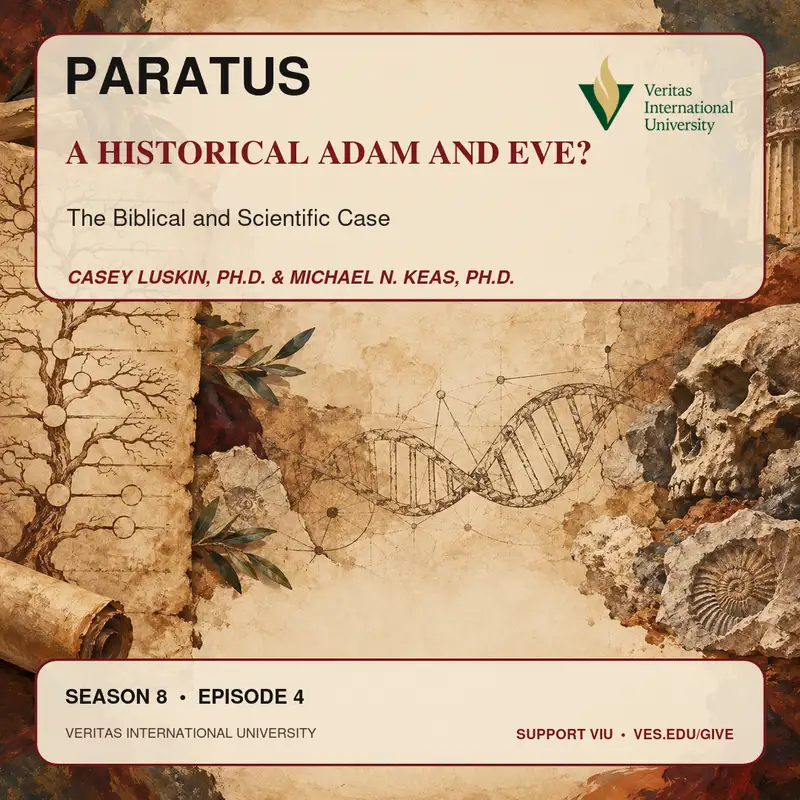
What Is the Biblical and Scientific Case for a Historical Adam and Eve? | Casey Luskin & Michael Keas
Download MP3Were Adam and Eve real historical people, and how should Christians evaluate scientific arguments about human origins? Host Luke Betzner welcomes Dr. Casey Luskin and Dr. Michael Keas to examine the biblical case for a historical Adam and Eve, the fossil and genetic evidence discussed in debates over human ancestry, and proposals for reconciling Christianity with evolutionary accounts of human origins.
Drawing on The Comprehensive Guide to Science and Faith, the conversation explores Jesus’ and Paul’s references to Adam and Eve, four alternative models of human origins, questions surrounding biblical genealogies and the dating of humanity, and population-genetics modeling. Luskin and Keas explain their arguments for the traditional view and discuss how evidence and coherence shape their evaluation of competing models. Their interpretations and critiques are presented as the guests’ positions in an ongoing debate.
In this episode
- The biblical case for a historical Adam and Eve
- Fossil evidence and human genetic diversity
- Evolutionary creationism, Homo divinus, genealogical Adam and Eve, and Homo heidelbergensis proposals
- Genesis genealogies and the question of when Adam and Eve lived
- Population-genetics models and the possibility of an original pair
- Recommended books and further reading
Chapters
00:27 Introduction and guests
03:47 The biblical case for a historical Adam and Eve
12:16 Two scientific challenges: fossils and genetics
18:53 Four alternative models of human origins
27:53 Evaluating the models against Scripture
36:15 Do biblical genealogies establish a date?
40:18 Genetic diversity and a primordial pair
47:45 Final thoughts
50:50 Recommended reading
53:41 Support Paratus and closing
00:27 Introduction and guests
03:47 The biblical case for a historical Adam and Eve
12:16 Two scientific challenges: fossils and genetics
18:53 Four alternative models of human origins
27:53 Evaluating the models against Scripture
36:15 Do biblical genealogies establish a date?
40:18 Genetic diversity and a primordial pair
47:45 Final thoughts
50:50 Recommended reading
53:41 Support Paratus and closing
Resources mentioned
- The Comprehensive Guide to Science and Faith, edited by Joseph M. Holden, William A. Dembski, and Casey Luskin
- C. John Collins, Did Adam and Eve Really Exist? and Reading Genesis Well
- Casey Luskin, “Comparing Contemporary Evangelical Models Regarding Human Origins,” Religions
- Discovery Institute: discovery.org
About Paratus
Paratus is the podcast of Veritas International University, helping Christians develop a biblical worldview and think scripturally and soundly about faith and culture. Learn more at ves.edu.
Paratus is the podcast of Veritas International University, helping Christians develop a biblical worldview and think scripturally and soundly about faith and culture. Learn more at ves.edu.
Support Paratus and Veritas International University
Help sustain this outreach at ves.edu/give.
Help sustain this outreach at ves.edu/give.
Creators and Guests
Host
Luke Betzner
Director of Institutional Effectiveness & Associate Professor of Theological and Historical Studies at Veritas International University.
Guest
Dr. Casey Luskin
Casey Luskin is a scientist and an attorney with graduate degrees in science and law, giving him expertise in both the scientific and legal dimensions of the debate over evolution. He holds a PhD in Geology from the University of Johannesburg where he specialized in paleomagnetism and the early plate tectonic history of South Africa. He earned a law degree from the University of San Diego, where he focused on First Amendment law, education law, and environmental law. His B.S. and M.S. degrees in Earth Sciences are from the University of California, San Diego, where he studied evolution extensively at the graduate and undergraduate levels, and conducted geological research at Scripps Institution for Oceanography. Dr. Luskin has been a California-licensed attorney since 2005, practicing primarily in the area of evolution-education in public schools and defending academic freedom for scientists who face discrimination because of their support for intelligent design (ID).
Guest
Dr. Michael Keas
After earning a Ph.D. in the history of science from the University of Oklahoma, Mike Keas won research grants from such organizations as the National Science Foundation and the American Council of Learned Societies. He experienced some of the last historic moments behind the Berlin Wall as a Fulbright scholar in East Germany. Keas serves as lecturer in the history and philosophy of science at Biola University. He has written numerous articles, including “Systematizing the Theoretical Virtues” in the top-tier philosophy journal Synthese. This essay analyzes twelve traits of reputable theories, and has generated dialogue across many fields. With a quarter-century of experience teaching science and its history to college students, Keas is qualified to lay out the facts to show how far the conventional wisdom about science and religion departs from reality. He has done so in the ISI book Unbelievable: 7 Myths about the History and Future of Science and Religion.