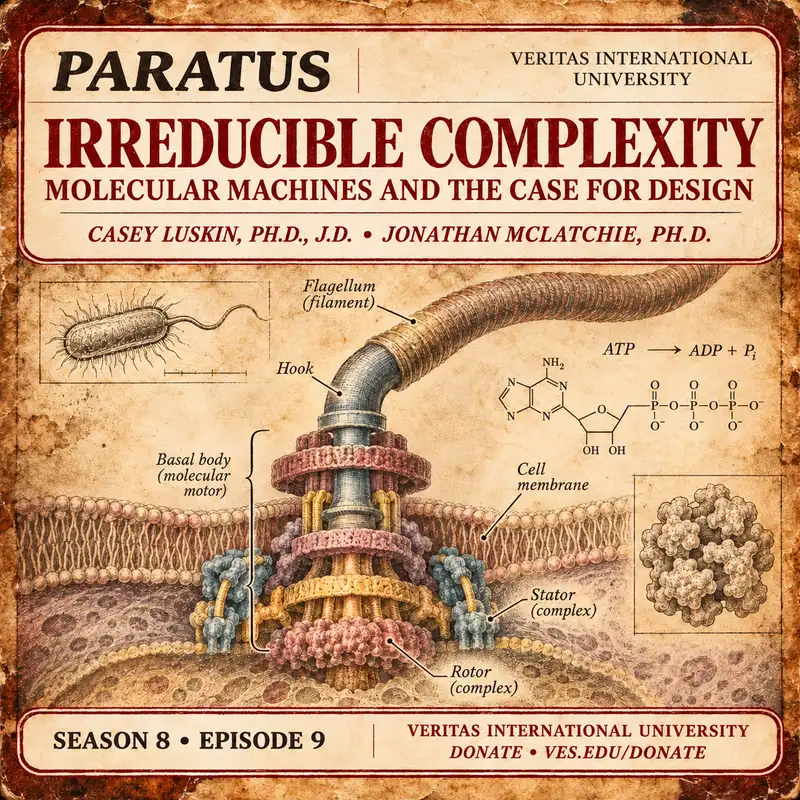
Irreducible Complexity: Can Darwinian Evolution Build Molecular Machines? | Casey Luskin & Jonathan McLatchie
Download MP3Can Darwinian evolution build the irreducibly complex molecular machines found inside living cells—or do these systems point beyond unguided processes to intelligent design?
Host Luke Betzner welcomes back Casey Luskin, Ph.D., J.D., Associate Director, Research Director, and Senior Fellow at Discovery Institute’s Center for Science and Culture, and Jonathan McLatchie, Ph.D., Resident Biologist and Fellow at the Center for Science and Culture. Together they examine the biochemical challenge of irreducible complexity: systems whose coordinated parts must work together to accomplish a higher-level function.
The discussion moves from Darwin’s own proposed test of his theory to neo-Darwinism, DNA replication, molecular machines, apoptosis, co-option, and evidence that beneficial mutations often degrade or disable existing functions rather than construct genuinely new machinery. The guests also explain the positive case for design using empirical reasoning and Bayesian likelihoods.
In this episode:
- What irreducible complexity means—and why it matters
- Darwin’s “numerous successive slight modifications” criterion
- What neo-Darwinism added through genetics and DNA
- Why mutation and selection struggle to construct coordinated systems
- The DNA replisome, bacteriophages, apoptosis, and molecular machines
- Michael Behe’s “Darwin devolves” thesis
- Experiments involving E. coli, citrate metabolism, and the TRP-A gene
- Polar bears, APOB, and adaptation through loss of function
- Co-option, teleology, and the positive case for intelligent design
Chapters
00:26 — Introduction: Casey Luskin and Jonathan McLatchie
01:28 — The guests and their current research
03:44 — Defining irreducible complexity
05:11 — Darwin’s test and the challenge of molecular biology
10:08 — What neo-Darwinism added to Darwin’s theory
18:46 — Mutation, information loss, and Darwin Devolves
22:54 — The irreducibly complex DNA replication machinery
29:24 — Research on DNA replication and bacteriophages
34:11 — Molecular machines inside the cell
38:50 — The “Third Way” and teleology in biology
43:25 — Apoptosis, foresight, and the co-option objection
47:47 — What beneficial-mutation studies actually show
50:10 — E. coli, citrate metabolism, and broken regulation
52:19 — Polar bears, APOB, and adaptive degradation
57:22 — The Bayesian positive case for design
01:01:01 — Final takeaways and the limits of co-option
01:05:54 — Recommended resources
01:07:30 — Support Paratus and preview of Episode 10
Guests
Casey Luskin, Ph.D., J.D. — Associate Director, Research Director, and Senior Fellow, Center for Science and Culture, Discovery Institute.
Jonathan McLatchie, Ph.D. — Resident Biologist and Fellow, Center for Science and Culture, Discovery Institute.
Resources mentioned
- Darwin Devolves by Michael J. Behe
- Darwin’s Black Box by Michael J. Behe
- Undeniable by Douglas Axe
- Science and Culture Today
- Secrets of the Cell with Michael J. Behe
- The Comprehensive Guide to Science and Faith, edited by William A. Dembski, Casey Luskin, and Joseph M. Holden
About Paratus
Paratus—Latin for “prepared”—is the broadcast ministry of Veritas International University. We help Christians develop a biblical worldview and think scripturally and soundly about the Christian faith and contemporary culture.
Learn more at ves.edu. Help sustain this outreach through a tax-deductible gift at ves.edu/donate.
Creators and Guests
Guest
Dr. Casey Luskin
Casey Luskin is a scientist and an attorney with graduate degrees in science and law, giving him expertise in both the scientific and legal dimensions of the debate over evolution. He holds a PhD in Geology from the University of Johannesburg where he specialized in paleomagnetism and the early plate tectonic history of South Africa. He earned a law degree from the University of San Diego, where he focused on First Amendment law, education law, and environmental law. His B.S. and M.S. degrees in Earth Sciences are from the University of California, San Diego, where he studied evolution extensively at the graduate and undergraduate levels, and conducted geological research at Scripps Institution for Oceanography. Dr. Luskin has been a California-licensed attorney since 2005, practicing primarily in the area of evolution-education in public schools and defending academic freedom for scientists who face discrimination because of their support for intelligent design (ID).
Guest
Dr. Jonathan McLatchie
Dr. Jonathan McLatchie holds a Bachelor's degree in Forensic Biology from the University of Strathclyde, a Masters (M.Res) degree in Evolutionary Biology from the University of Glasgow, a second Master's degree in Medical and Molecular Bioscience from Newcastle University, and a PhD in Evolutionary Biology from Newcastle University. Previously, Jonathan was an assistant professor of biology at Sattler College in Boston, Massachusetts. Jonathan has been interviewed on podcasts and radio shows including "Unbelievable?" on Premier Christian Radio, and many others. Jonathan has spoken internationally in Europe, North America, South Africa and Asia promoting the evidence of design in nature.